
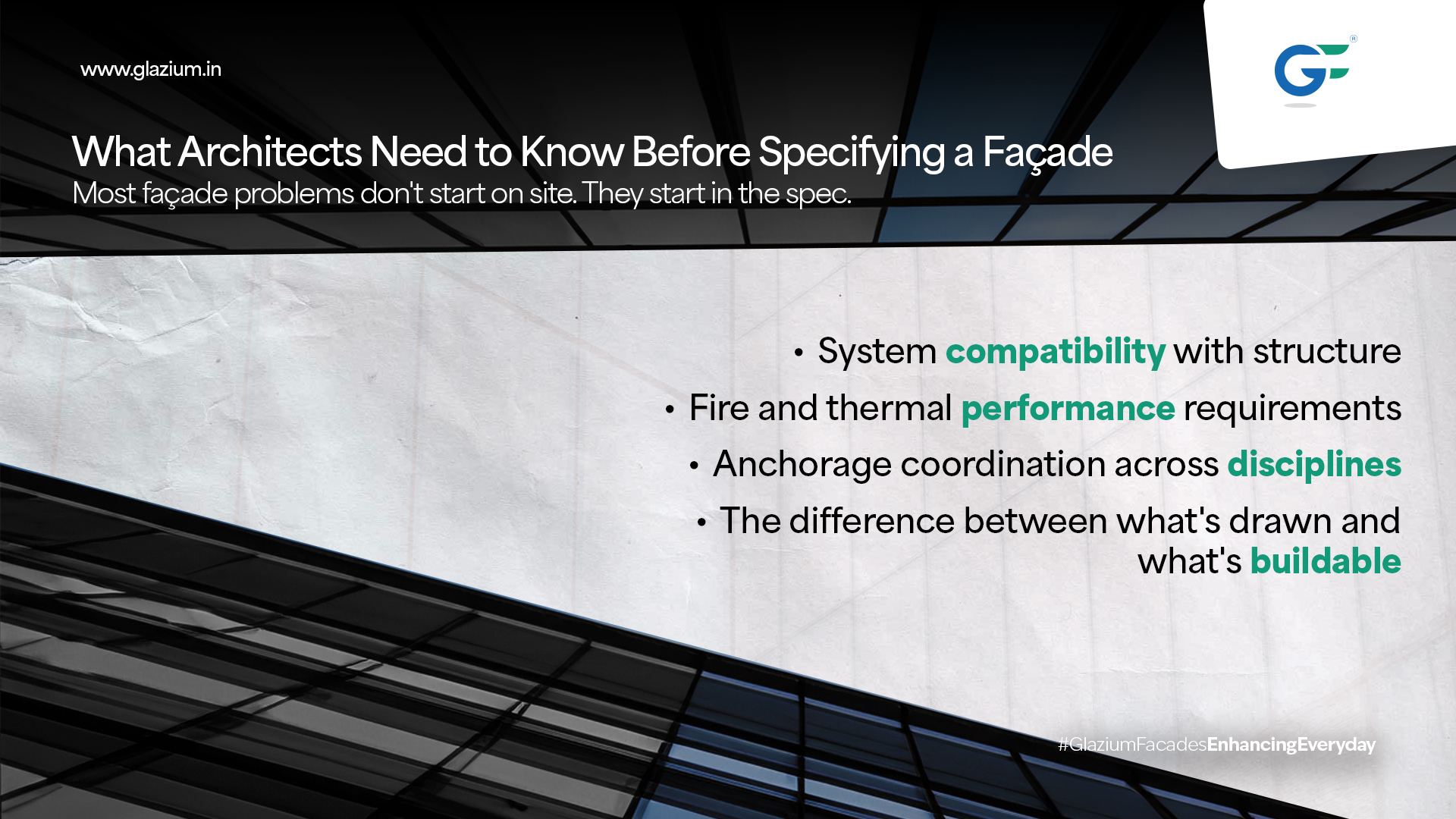
Most façade problems don’t begin during installation. They begin much earlier—at the specification stage.
A façade is far more than an exterior finish. It influences a building’s performance, safety, energy efficiency, and long-term maintenance. Before selecting a façade system, architects should evaluate a few critical factors that can significantly impact project success.
1. Structural Compatibility Matters
Every façade system interacts differently with the building structure. Slab edges, structural movement, tolerances, and load transfer must all be considered before finalizing the design.
A visually appealing façade that isn’t coordinated with the structure can lead to costly modifications during execution.
2. Fire and Thermal Performance Cannot Be an Afterthought
Modern façades are expected to meet stringent fire safety and energy performance requirements.
Architects should ensure specifications address:
• Fire-rated assemblies and barriers
• Material combustibility
• Thermal insulation requirements
• Solar heat gain and energy efficiency
The right façade system should not only look good but also contribute to occupant safety and building performance.
3. Anchorage Coordination Is Critical
Façade anchorage often involves coordination between architectural, structural, and MEP teams.
Without early planning, clashes can occur during construction, leading to delays and redesigns. Proper anchorage design ensures the façade performs as intended throughout the building’s life cycle.
4. What Is Drawn Must Be Buildable
Some façade details work well on paper but become challenging to fabricate, transport, or install.
Factors such as panel sizes, access requirements, installation methods, and maintenance should be considered during the design stage. Constructability is just as important as aesthetics.
5. Think Beyond Day One
A façade will remain on a building for decades. Maintenance access, replacement strategies, and durability should be part of the specification process from the start.
The most successful façade designs balance appearance, performance, and long-term practicality.
Conclusion
A well-specified façade does more than define a building’s appearance—it helps ensure safety, efficiency, durability, and smooth project execution.
By considering structural compatibility, fire and thermal performance, anchorage coordination, and constructability early in the design process, architects can avoid common challenges and create façades that perform as well as they look.